

Table of Contents
Introduction
Buying gold is a fascinating adventure in a world where the management of Western countries (France, the United States) seems fragile and debt is spiraling out of control! After exploring the ‘Stocks’ asset class with my favorite ETF, the MSCI WORLD ETF, and REAL ESTATE through investments on Bricks and REITs, it’s time for another essential category, briefly mentioned in my article on asset allocation: commodities! This article reveals all the opportunities for buying gold.
We don’t always think about it, but it’s an excellent purchase to consider because for centuries, gold has held a unique place in the economic and cultural history of humanity. The ultimate precious metal, it embodies wealth, security, and legacy. Even today, in the face of economic instability, geopolitical crises, and monetary erosion, gold remains an essential safe-haven asset. But buying gold is not just about purchasing a few bars: there are different forms, strategies, and precautions to know before you dive in.
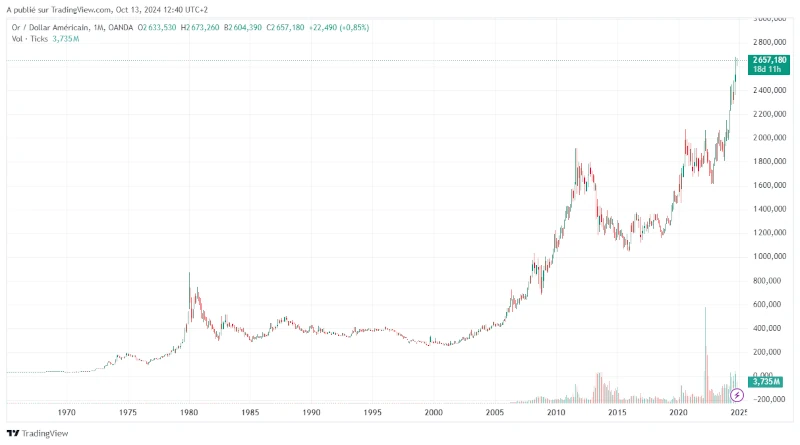
Link to the chart above : https://fr.tradingview.com/chart/?symbol=OANDA%3AXAUUSD
I was talking about physical gold, in coins or bars, but did you know that you can also invest in ‘paper’ gold and various commodities on the stock exchange via ETCs? Whether it’s agricultural products, energy, or precious metals, the opportunities are endless! As always, I’ll share my preferences and the enriching experiences I’ve gained from my investments over the past few years.
Why invest in gold ?
Safe-haven asset

Gold is often regarded as a safe-haven asset: it holds its value even when the economy is struggling, geopolitical tensions rise, or inflation erodes the purchasing power of currencies. Unlike currencies or riskier investments, it remains a benchmark of stability.
Inflation hedge
Over 5 full years (2020-2025), the cumulative increase [in the gold price] is approximately +97% (from an average of $1,773 in 2020 to about $3,143 in 2025), while cumulative inflation in France was about 15.8%.
This means you have lost €15.80 in purchasing power on your €100 grocery basket between January 2020 and today, while a gold owner could today buy nearly 2 grocery baskets like yours by selling their gold.
Portfolio diversification
The correlation between gold and financial markets, represented by the S&P 500, is measured using a correlation coefficient ranging from -1 to 1. -1 indicates a negative correlation, and 1 indicates a perfect correlation. Historically, the correlation between gold and stocks has been low or negative, with a long-term average close to 0, and negative during financial crises.
It’s simple: among copper, silver, and gold, only gold offers an intrinsic safe-haven value, decoupled from economic fluctuations. Copper, an industrial commodity, follows economic cycles, while silver oscillates between gold and copper.
Gold benefits from steady demand
Gold is a store of value widely endorsed by all. Individuals buy it (bars, coins, ETFs) to protect their savings. Jewelers consume 50% of global demand for luxury and cultural purposes. Central banks hold 36,000 tonnes and bought 900 tonnes in 2025 to secure their reserves. The result: steady demand (4,000 tonnes/year) that supports prices. Everyone is betting on gold—what about you?
High liquidity
Gold can be converted into cash almost instantly, anywhere in the world, without significant loss of value, even during times of crisis. Moreover, the gold spot market handles around $200 billion per day, surpassing many stock markets.
Gold facilitates wealth inheritance.
When we talk about gold over the long term, we inevitably think of passing it down from generation to generation through coins, bars, and jewelry, rather than financial markets and asset allocation.
Economic context and the appeal of gold as a safe-haven asset.
Investing in gold is a fascinating adventure, especially in a world where the management of Western countries (like France or the United States) seems fragile, with repeated crises and spiraling debt.
The different ways to buy gold
Physical gold: bars, coins, and jewelry
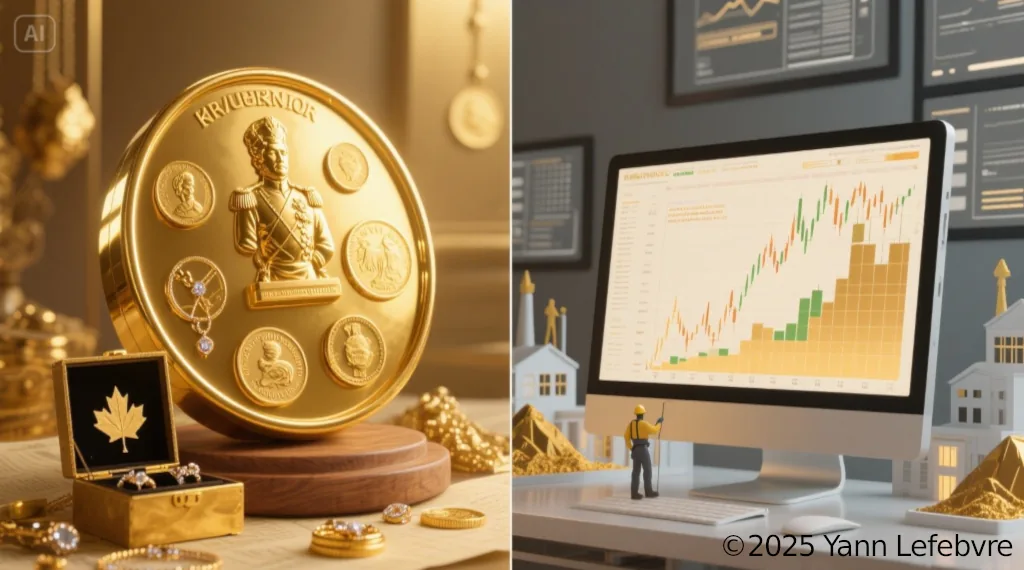
Physical gold is the most traditional form of investment. Whether in the form of ingots, small bars, iconic coins (Napoleon, Krugerrand, Maple Leaf…), or even jewelry, it offers the security of actual ownership.
- ✅ Advantges : tangible and reassuring, it escapes banking risks and allows for simple wealth transmission. Its value is universal and recognized everywhere in the world
- ❌ drawbacks : it involves costs (premium, storage, insurance) and requires security precautions. Additionally, its liquidity can vary depending on the form (a bar is less flexible than a small coin)
Paper gold: ETFs and gold mining stocks
Paper gold allows you to gain exposure to the metal without having to hold it physically. This includes gold-backed ETFs (Exchange Traded Funds), as well as shares of specialized mining companies.
- ✅ Advantges : Easily accessible through a securities account, highly liquid, with no storage issues. It also allows for diversification with financial products linked to gold.
- ❌ drawbacks : Dependence on financial markets, counterparty risk (in the event of a banking crisis), and less security than an asset held outright. Additionally, the value of mining stocks can be influenced by other factors (management, production costs, market conditions).
Gold mining company stocks: Investing in gold mines on the stock exchange is fascinating, but no company is exclusively dedicated to gold, as mining involves various metals. ETFs and ETCs: I prefer an ETC to buy gold in a simple and efficient way.
Paper gold: ETCs (Exchange Traded Commodities)
Definition and how it works
Nature of ETCs: ETCs are financial products similar to ETFs, explained in my article on asset allocation. ‘Exchange Traded Commodity’ refers to a commodity traded on the stock exchange, offering a flexible investment solution.
Structure: ETCs are debt securities backed by commodities, issued by licensed management companies, such as Amundi in France or BlackRock in the United States.
Choosing the ETC issuer for buying gold
- Reputation and financial stability
- Track record and experience: Favor issuers with extensive experience in asset management, such as Amundi or BlackRock, which have been operating for decades. A solid track record indicates an ability to manage crises.
- Credit rating : Check the issuer’s credit rating (e.g., via S&P, Moody’s). A high rating (e.g., AA or AAA) reflects a low probability of default, reducing issuer risk.
- Transparency and quality of management
- Clear information: A good issuer provides detailed information on the ETC’s structure, fees, and underlying assets (e.g., physical gold or derivatives). Consult the product factsheets or annual reports on their official website.
- Regulatory compliance: Make sure the issuer is authorized by recognized authorities (e.g., AMF in France, SEC in the United States) to ensure compliance with financial standards.
- ETC structure and guarantees
- Asset backing: Check whether the ETC is physically backed (e.g., gold stored in vaults) or based on derivatives. Physically backed ETCs, such as the iShares Physical Gold ETC, reduce counterparty risk.
- Guarantees or collateral: Some issuers offer guarantees (e.g., collateralization) to protect investors in the event of default. Check the details in the ETC’s documentation.
- Fees and associated costs
- Management fees (TER): Compare the Total Expense Ratio. For example, a TER of 0.12% (as with the iShares Physical Gold ETC) is competitive. Low fees increase net returns.
- Hidden costs: Check for additional fees (e.g., storage costs for physical gold or spreads on transactions) to avoid any surprises.
- Liquidity and market access
- Trading volume: Choose an issuer whose ETCs show high trading volume on the stock exchange, ensuring sufficient liquidity to buy or sell easily.
- Accessibility : Make sure the ETC is listed on exchanges accessible through your broker (e.g., Euronext for Amundi, NYSE for BlackRock).
Features and benefits
- Replication: An ETC tracks the price of a commodity or a basket of commodities, unlike ETFs, which generally track a stock market index, whether rising or falling.
- Liquidity and flexibility: ETC shares can be bought or sold on the stock exchange during trading hours, offering a practical and accessible investment solution.
- Convenience: With ETCs, there’s no need to store commodities—like barrels of oil—in your living room!
My preferred gold ETC for buying gold on the stock exchange: iShares Physical Gold ETC
| Nom du produit | iShares Physical Gold ETC |
|---|---|
| Code ISIN Physical Gold ETC | IE00B4ND3602 |
| Link on DEGIRO | https://www.degiro.fr/connaissances/academie-des-investisseurs/lecon-pour-debuter/investir-or |
| Indice | The product tracks the spot price of gold in US dollars |
| Investment focus | Gold commodity |
| Fund size | 15 568 M d’EUR. L’ETC a été lancé le 8 avril 2011 |
| Total Expense Ratio (TER) | 0,12% |
| Currency risk | Not hedged against currency risk |
| Distribution | Capitalisation (automatically reinvests the dividends acquired) |
| Fund domicile | Irlande |
| Promoteur | iShares |
The different places to buy gold

Physical gold: jewelers, specialized brokers, and online platforms
Jewelers remain a traditional route, particularly for gold jewelry, although these often include a significant premium related to design and craftsmanship. Specialized brokers—whether in physical stores or through reputable online platforms—allow you to buy certified coins and bars, with transparency on the spot price and the premium applied
- ✅ Advantages : Direct ownership, security of a tangible asset, and potential for inheritance transmission.
- ❌ Limitations : Need to verify the seller’s reliability, premium and storage fees, and increased vigilance regarding online counterfeits.
Paper gold: banks and financial institutions
Exposure to gold in financial form is generally achieved through banks, financial institutions, and online brokerage platforms. You can buy gold-backed ETFs, certificates, or invest in mining company shares. These solutions allow you to access gold without logistical constraints.
- ✅ Advantages : High liquidity, ease of buying and selling, and no storage issues
- ❌ Limitations : Dependence on the financial system, potential management fees, and the absence of physical ownership, which removes part of the ‘safe-haven’ role.
Before buying gold
Before diving into buying gold, it is essential to take a few precautions.
- Analyze the price of gold: monitor market trends to avoid buying when the metal is in the midst of a speculative bubble. Gold remains a safe-haven asset, but like any asset, it can go through phases of overvaluation, and unlike other financial assets, it does not pay dividends.
- Evaluate the costs associated with the purchase: besides the price of the metal, you must factor in the dealer’s commission (the ‘premium’), as well as any additional costs such as insurance or storage fees if you are buying a bar or a large volume.
- Plan for storage: unlike paper gold (ETFs, certificates, etc.), physical gold requires a secure place for safekeeping
Storage options :
- At home: using an appropriate safe, reinforced security measures, but increased risk of theft
- In a bank or with a specialized depository: a more secure solution, often including insurance, but incurring annual custody fees.
In summary, buying gold requires not only choosing the right form (physical or paper), but also anticipating hidden costs and practical constraints that can reduce long-term profitability.
Buy my favorite ETC for buying gold: iShares Physical Gold ETC!
You buy this « iShares Physical Gold ETC » just like you would buy a stock. Check on your bank’s website.
| Website name | Website URLs |
|---|---|
| Other link on justetf.com | https://www.justetf.com/fr/etf-profile.html?isin=IE00B4ND3602#apercu |
This iShares ETC stands out for its highly competitive fees of just 0.12%, among the lowest in its category. Established for over 13 years, it offers shares priced at around €40, making it ideal for many investors. Moreover, with iShares, you benefit from a solid and reputable management company that effectively minimizes issuer-related risks.
Selling your gold?
If you own paper gold, selling works the same way as buying—directly on the financial markets through your bank or online broker. Ideally, it’s best to sell when the price is favorable, often during periods of high instability (economic crises, geopolitical tensions, etc.). However, since gold tends to hold or even increase its value over the long term, many investors choose not to sell it, preferring to pass it on or only use it in case of a temporary need for liquidity.
For physical gold, the simplest solution is to sell back where you bought it: authorized shops, specialized counters (for example in Nice), or recognized platforms like Goldavenue. These channels generally offer more security and transparency on the applied price.
Finally, there is also the option of going through auction houses. These can be particularly interesting for rare coins, antique bars, or high-value jewelry that may attract collectors and exceed the simple price of the metal
Conclusion
Investing in gold means choosing a timeless safe-haven asset that protects against inflation, diversifies your portfolio, and offers exceptional liquidity, while embodying a lasting heritage. Whether you opt for physical gold (bars, coins, or jewelry) or paper gold through ETFs or mining stocks, each form of investment has its advantages and constraints. The key is to do your research, monitor market trends, anticipate costs (premium, storage, insurance), and choose reliable buying and selling channels, such as specialized brokers or recognized platforms. In a world marked by economic and geopolitical instability, gold remains a solid bulwark to secure your wealth. So, are you ready to make your savings shine?
Here’s an interesting video in English, with automatic translation available on YouTube, that could confirm or completely dismantle my views on the product « iShares Physical Gold ETC » for buying gold
IMPORTANT DISCLAIMER
I am not a financial advisor. I share thoughts that I personally apply and am happy to pass along. This is not investment advice. The views expressed are summarized and mixed with personal reflections that are solely my own. These are ideas to consider; it is essential to educate yourself and seek multiple sources of information to make informed decisions. No buy or sell recommendations are made. Each individual must invest according to their investor profile, risk tolerance, budget, age, personal and family situation, level of financial literacy, and investment horizon. Everyone is responsible for their own financial decisions