Table des matières
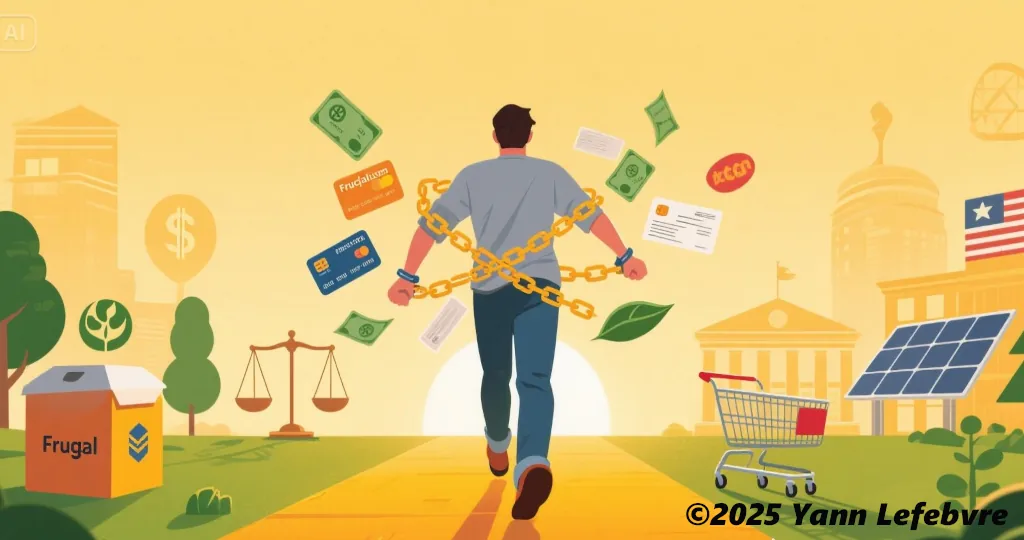
What if you could live free, without being chained to financial constraints? My name is Yann, and frugalism has changed my view of money. It’s not a trend—it’s a philosophy: living better with less. Today, I’ll give you a summary in under 6 minutes of what frugalism is, where it comes from, and how it can transform your life.
First of all, I want to clarify the definition, far from common misconceptions. According to Le Robert dictionary, it is about sobriety and prudent management of resources, especially financial ones, through saving. PERIOD : Saving money.
What is frugalism ?
It is a pragmatic lifestyle, rooted in the present, with a philosophical dimension. It can have ecological or political impacts, but its primary goal is to free oneself from the financial constraints of Western societies.
Contrary to what some training websites may suggest, it is neither innate nor complex. It requires varying degrees of effort depending on your personality, your upbringing, or your outlook on life. For some, it comes naturally—you might already be a frugalist without knowing it! For others, this choice may seem restrictive or unprecedented.
Where does frugalism come from ?
Far from being an American invention, frugality has its roots in Antiquity. Aristotle and Epicurus considered it a path to wisdom. In the Middle Ages, Christian monks lived frugally to share their goods. During the Renaissance, Erasmus and Montaigne denounced extravagance.
In the East, Hinduism and Buddhism have long advocated voluntary simplicity. In the 1970s and 1980s, the Simple Living and Voluntary Simplicity movements promoted reduced consumption. Modern frugalism re-emerged after the 2008 crisis, driven by ecological concerns and critiques of capitalism.
What are the goals of frugalism ?

It aims to reduce consumption in order to save, whether out of ecological conviction, opposition to capitalism, or simple common sense. The ultimate goal? Financial freedom: passive income exceeding your expenses (example book: Rich Dad Poor Dad by Robert Kiyosaki).
For me, it means managing one’s savings, maintaining freely chosen activities, and adopting a modest lifestyle for an active early retirement, far from excess or idleness.
My goals with frugalism !
My cautious nature, my upbringing, and my life path have shaped me into a thrifty and responsible person.
The tough jobs of my youth and disappointing professional experiences pushed me toward autonomy. The mediocrity of the French state led me to reject overtime, despite my professional skills and the demand.
By reducing my working hours while choosing more rewarding activities, I spend less and better. This modest lifestyle, imposed by my choices and circumstances, allows me to save. Imagining a year of intense work, with a high salary, that can generate substantial savings!

Thus, I aspire to financial freedom and early retirement, while staying active and true to my values, far from the excesses of consumer society.
Financial freedom, according to Robert Kiyosaki (Rich Dad Poor Dad), means having passive income that exceeds your living expenses. For me, it is not limited to accumulating a fortune to satisfy every whim.
Being a frugalist is not about lounging on a deck chair, growing old in the sun, risking cirrhosis, dressing like a luxury clown, or being bored in a mindless crowd!
Your frugalist goals !
This video is interesting, although the strict rules are not necessarily worth remembering, but the idea is worth following…
Everything is possible with frugalism! If you’re already a frugalist, congratulations! If not, move at your own pace: start with small savings, change your housing or job, or impose stricter constraints on yourself according to your personal or collective ambitions (ecological, political).
An extreme approach is to live well below your means from a young age, saving 50 to 60% of your salary. By saving massively over two to three decades, you could build a solid nest egg for retirement as early as age 40-50. This requires high income—a challenge in France given the current economic climate—and discipline in the face of society’s constant temptations.
A gentler path, without upending your daily life or delving deeply into wealth management, is possible, but transforming your future requires adjustments in behavior and mindset.
Frugalism is not for everyone, so no universal advice here. However, explore some investment ideas (cash, stocks, commodities, real estate, bonds within a sound asset allocation). Example on the website.

Many websites offer tips for saving money in everyday life or setting money aside for the long term. Look into both of these aspects, depending on your interest in this lifestyle. Honestly, I am convinced that frugalism can only enrich you and improve your life! I highly recommend the website Finance pour tous, a treasure trove of practical and accessible ideas: https://www.lafinancepourtous.com/decryptages/finance-perso/epargne-et-placement/psychologie-et-finance/